

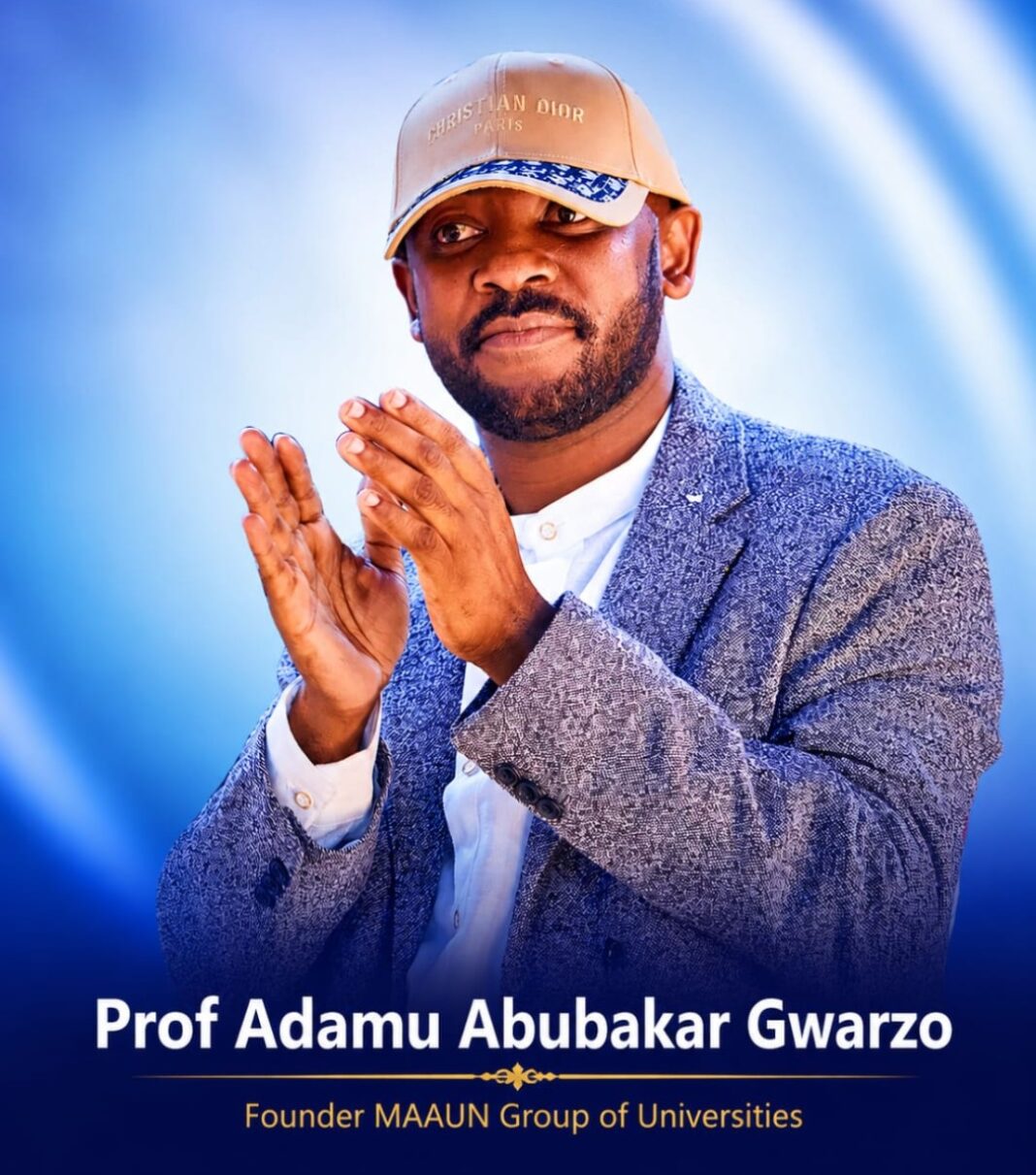

Professor Adamu Abubakar Gwarzo has, within just over a decade, emerged as one of Africa’s most influential private education investors. Unlike many founders who concentrate on a single institution, he has built a growing network of universities across Nigeria and the Republic of Niger, positioning himself as an advocate for accessible, internationally oriented higher education.
He founded the Maryam Abacha American University of Niger (2013), later established the Maryam Abacha American University of Nigeria (MAAUN), Kano, and subsequently founded Franco-British International University (FBIU), Kaduna and the Canadian University of Nigeria, Abuja. Today, he serves as President of the MAAUN Group of Universities.
His philosophy goes beyond establishing universities. Professor Gwarzo consistently advocates internationalisation, research collaboration, innovation and industry-driven education, believing African universities must compete globally rather than remain locally confined. Under his leadership, the institutions have pursued partnerships with universities and academic organisations across Europe, Asia, North America and Africa while encouraging student exchange, research collaboration and curriculum aligned with international standards.
One factor frequently associated with his success is his youthful leadership. At a relatively young age compared with many university proprietors in Africa, Professor Gwarzo has embraced technology, digital learning, international networking and rapid institutional expansion. His leadership style combines entrepreneurial decision-making with academic administration, allowing quicker implementation of new programmes, infrastructure development and international partnerships.
Why MAAUN Continues Its Consistent Growth
The steady rise of MAAUN is not accidental. Several strategic factors explain its continuous expansion:
Strong investment in infrastructure, including modern lecture theatres, laboratories, health facilities and student accommodation.
International outlook, making foreign collaborations a priority rather than an afterthought.
Focus on employability, with programmes designed around market needs.
Research-driven policies, encouraging academic excellence and innovation.
Expansion into specialised fields, including medicine, nursing, engineering, computing and emerging technologies.
Quality assurance and regulatory compliance, helping the institution maintain credibility and public confidence.
These strategies have enabled MAAUN to attract students from Nigeria and several African countries, strengthening its reputation as an international university.
Support for Nigerian Educational Institutions
Professor Gwarzo’s influence extends beyond his own universities. He has consistently encouraged collaboration among Nigerian higher institutions, offering mentorship, institutional partnerships and technical support to emerging universities.
Through his leadership within the Association of African Private Universities (AAPU), he has promoted stronger academic cooperation across the continent. He has repeatedly called for universities to embrace internationalisation and has offered to facilitate partnerships between Nigerian institutions and foreign universities.
He has also invested in scholarships, educational interventions and community development initiatives, particularly in Northern Nigeria.
His support for schools, students and underserved communities has earned him recognition as a philanthropist committed to reducing educational inequality.
A Vision Beyond Building Universities
Professor Gwarzo has publicly stated that his ambition is not merely to establish universities but to create centres of excellence capable of competing internationally. His participation in major global education conferences, including the European Association for International Education (EAIE), reflects this commitment to positioning African universities within the global higher education ecosystem.
Professor Adamu Gwarzo’s growing reputation in African education stems from a combination of vision, youthful leadership, strategic investment and an unwavering commitment to educational access.
The rapid growth of MAAUN and its sister institutions reflects a deliberate model centred on quality infrastructure, international collaboration, research excellence and community impact. Rather than focusing solely on expanding campuses, he has sought to build institutions capable of producing globally competitive graduates while contributing to Nigeria’s and Africa’s broader educational development.